Hand Crafted Branches Floral: Elevating Digital Design with Organic Versatility
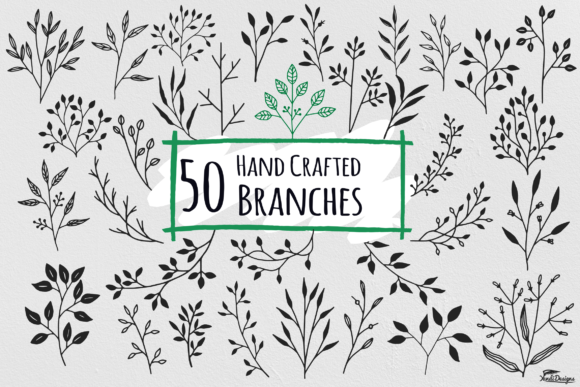
In an era dominated by minimalist aesthetics and rigid geometric grids, the demand for organic, human-centric design elements has seen a significant resurgence. Creators and businesses alike are seeking ways to soften digital interfaces and print materials without sacrificing professionalism. The Hand Crafted Branches Floral collection addresses this specific need by bridging the gap between traditional botanical illustration and modern vector utility. This comprehensive set of 50 floral branch elements offers more than just decoration; it provides a foundational toolkit for designers who require flexibility, scalability, and authentic texture in their visual communication.
The relevance of such a collection extends beyond simple ornamentation. As brands strive to differentiate themselves in saturated markets, the ability to customize generic assets becomes paramount. Unlike raster-based clip art that degrades when resized or lacks color adaptability, these hand-crafted branches are engineered for professional workflows. They represent a shift toward sustainable design practices where high-quality, editable assets reduce the time spent drawing from scratch while maintaining the bespoke appearance that clients and audiences increasingly expect.
The Evolution of Botanical Assets in Modern Workflows
Historically, incorporating floral elements into commercial design required either hiring a specialized illustrator or relying on low-resolution stock imagery that limited creative freedom. The landscape has shifted dramatically with the democratization of vector software and the rise of independent creators. Today’s designers operate across multiple platforms, requiring assets that are as comfortable in a laser cutter file as they are in a high-end branding suite. The Hand Crafted Branches Floral set reflects this evolution by prioritizing format diversity and editability over static presentation.
This transition is also driven by changing consumer perceptions. Audiences have developed a sophisticated eye for design, often associating overly polished, synthetic graphics with impersonal corporate messaging. Conversely, hand-drawn styles signal authenticity, care, and artisanal quality. However, creating fifty unique, cohesive botanical illustrations for every new project is economically unfeasible for most freelancers and agencies. Curated libraries like this one solve the efficiency problem, allowing professionals to leverage the emotional resonance of hand-drawn art within tight production schedules. The "hand-crafted" aspect is not merely a stylistic choice but a strategic response to the fatigue associated with AI-generated or purely algorithmic patterns.
Technical Flexibility Across Creative Ecosystems
A critical factor in the utility of any digital asset is its compatibility with existing technology stacks. The modern creative workflow is rarely monolithic; a designer might sketch in Procreate, refine vectors in Adobe Illustrator, layout in Affinity Publisher, and optimize for web using Inkscape. This collection acknowledges that reality by providing files in Ai CS2, EPS 10, afdesign, PSD, and SVG formats. This broad spectrum ensures that whether you are a legacy Adobe user, an Affinity convert, or an open-source advocate, the assets remain accessible and functional.
- Adobe Illustrator (Ai CS2 & EPS 10): These industry-standard formats ensure backward compatibility while retaining full node editability for complex path adjustments.
- Affinity Designer (.afdesign): Native support for the growing community of designers moving away from subscription models, preserving layer structures and effects.
- SVG & Inkscape Compatibility: Essential for web designers and crafters who rely on open standards and free software for scalable graphics and cutting machine preparation.
- PSD Files: Provides a rasterized option for photo editors and composite artists who prefer working with pixels or need smart object integration.
This multi-format approach eliminates the friction of file conversion, which often results in lost gradients, broken strokes, or expanded text. By including an Information.txt file, the package also respects the user's time by providing immediate guidance on usage rights and technical specifications, streamlining the onboarding process for new assets.
Practical Applications for Branding and Visual Identity
The primary strength of having 50 distinct branches lies in the capacity for variation. In logo design, consistency is key, but so is adaptability. A single floral motif can become stale if repeated identically across business cards, social media headers, packaging, and signage. With a diverse library of hand-crafted branches, designers can create a cohesive visual language where elements share a stylistic DNA but differ in form. One branch might frame a luxury skincare logo, while a simpler twig accent serves as a bullet point in a brochure, and a lush arrangement anchors a wedding invitation suite.
For entrepreneurs and small business owners managing their own marketing, this versatility translates directly to cost savings and brand agility. Instead of purchasing separate packs for logos, borders, and background textures, a single comprehensive set covers multiple use cases. The ability to easily recolor these vectors means that seasonal updates require only a palette swap rather than a complete redesign. A green-and-gold arrangement for winter can instantly transform into pastel pinks and greens for spring, keeping content fresh and relevant without additional expenditure.
Customization as a Standard Expectation
The phrase "fully editable" carries significant weight in professional circles. It implies that the user is not locked into the artist’s original vision. Nodes can be moved, strokes can be thickened or thinned, and individual leaves can be deleted or duplicated to suit specific spatial constraints. This level of control is essential for fitting organic shapes into rigid layouts. For example, a website hero section might require a branch that curves specifically around navigation buttons, or a product label might need foliage trimmed to avoid obscuring regulatory text.
Furthermore, the ease of recoloring supports accessibility and brand compliance. Designers can adjust contrast ratios to meet WCAG guidelines or match exact Pantone references without degrading image quality. This practical implication transforms the Hand Crafted Branches Floral set from a passive decorative resource into an active component of the design system. It empowers users to maintain visual integrity across diverse mediums, ensuring that the organic warmth of the illustration style does not come at the expense of functional clarity.
Meeting the Needs of Diverse Creative Communities
While professional graphic designers are a primary audience, the utility of these vectors extends to educators, hobbyists, and makers. The inclusion of SVG files specifically caters to the crafting community, where Cricut and Silhouette users require clean paths for vinyl cutting and engraving. Similarly, educators creating worksheets or presentation materials benefit from lightweight, scalable graphics that do not bloat file sizes or pixelate when projected on large screens.
For bloggers and content creators, these elements offer a way to establish a signature aesthetic without commissioning custom art. In the attention economy, visual distinctiveness aids in recognition and retention. Using consistent hand-drawn flora as dividers, pull-quote accents, or watermark elements helps build a recognizable personal brand. Because the files are vector-based, they load quickly on websites compared to high-resolution PNGs, supporting both SEO performance and user experience. This intersection of aesthetic appeal and technical performance highlights why well-structured asset packs remain vital tools in the digital creator’s arsenal.
Sustainable Design Practices and Asset Longevity
In discussing the value of this collection, it is worth noting the sustainability aspect of reusable design assets. Creating fifty high-quality illustrations consumes significant time and energy. By centralizing these efforts into a single, robust package, the collective carbon footprint of thousands of individual design projects is reduced. Users are not downloading massive raster files repeatedly; they are utilizing efficient vector code that scales infinitely without waste.
Moreover, the timeless nature of botanical art ensures longevity. Unlike trendy 3D renders or meme-referencing graphics that date quickly, hand-crafted florals possess a classic endurance. Investing in a set like Hand Crafted Branches Floral is an investment in assets that will remain usable and aesthetically pleasing for years. This forward-looking perspective encourages designers to build libraries of evergreen resources that support long-term creative growth rather than chasing fleeting visual fads.
Optimizing Integration and Best Practices
To maximize the value of these 50 branches, users should adopt a systematic approach to organization. Upon downloading, it is advisable to categorize the files by shape, density, or intended use within your asset management system. Renaming generic filenames to descriptive tags (e.g., "curved-willow-branch-left.svg") saves hours of searching later. Since the set includes an Information.txt file, reviewing licensing terms immediately prevents legal ambiguities down the line, especially for commercial merchandise or client work.
When integrating these elements into projects, consider the balance between negative space and detail. Hand-drawn lines carry inherent visual weight; overcrowding a layout with too many branches can create clutter. Use the variety within the set to create rhythm—alternating between dense focal points and sparse transitional elements guides the viewer’s eye naturally. For logo design, test the branches at extremely small sizes to ensure legibility. The vector nature allows for simplification; do not hesitate to remove intricate details that vanish at favicon size. Ultimately, treating these assets as raw material rather than finished products unlocks their true potential, enabling creations that feel uniquely tailored despite utilizing shared resources.