Evaluating the Floral Logo Template for Professional Brand Identity
In the crowded landscape of visual identity, finding a mark that balances aesthetic appeal with functional versatility is a persistent challenge for designers and business owners alike. The Floral Logo Template serves as a strategic starting point for organizations seeking to communicate growth, elegance, or organic connection without the prohibitive cost of bespoke illustration. While often associated strictly with florists or wedding planners, this template category offers broader utility when evaluated through the lens of symbolic communication. A well-executed floral motif can represent the heritage of a region, the ethos of an educational institution, or the natural composition of a consumer product. For professionals aged 20 to 50 managing tight deadlines and budgets, understanding the practical application and technical specifications of this asset is essential for making an informed investment.
Symbolic Versatility Beyond Botanical Businesses
The primary value proposition of a Floral Logo Template lies in its capacity to act as a visual shorthand. When used effectively, it functions as a memorable substitute for a full organizational name, conveying complex attributes instantly. While the literal interpretation suggests nature-related industries, the abstract application is where the template demonstrates true ROI. Consider a wellness clinic using a stylized lotus to signify renewal, or a regional tourism board utilizing native wildflowers to anchor geographic identity. In these contexts, the floral element is not merely decorative; it is a semantic tool that grounds the brand in specific values.
For entrepreneurs and marketers, this versatility reduces the cognitive load on the audience. A clean, vector-based floral icon can bridge the gap between traditional craftsmanship and modern minimalism. However, success depends on selecting a template that avoids cliché. Generic rose vectors may fail to distinguish a luxury skincare line from a Valentine’s Day promotion. The most effective templates offer enough structural uniqueness to be ownable while retaining the immediate recognition that floral imagery provides. This balance allows freelancers and small business owners to establish a professional presence quickly, reserving creative energy for messaging and strategy rather than initial concept sketching.
Technical Specifications and Workflow Integration
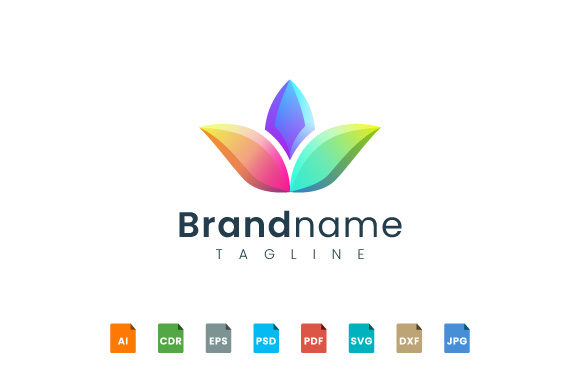
A digital asset is only as valuable as its compatibility with existing workflows. The Floral Logo Template distinguishes itself through comprehensive file inclusion, ensuring accessibility across different software ecosystems and skill levels. Upon purchase, users receive a ZIP archive containing eight distinct formats, each serving a specific function in the production pipeline.
- AI (Adobe Illustrator CC): The industry standard for vector editing. This file preserves layers, gradients, and editable anchor points, allowing for deep customization by professional designers.
- CDR (CorelDraw): Essential for sign makers, apparel printers, and laser engravers who rely on Corel’s ecosystem for physical production.
- EPS 10: A universal vector format compatible with older versions of Illustrator and alternative vector software like Affinity Designer or Inkscape. It ensures longevity and cross-platform reliability.
- PDF: Useful for high-resolution printing and client presentations where editability is not required but quality must be maintained.
- PSD (Photoshop): Provides a rasterized, layered environment for those integrating the logo into photo composites or web mockups without vector capabilities.
- DXF: Critical for CAD users, CNC machining, and vinyl cutting. This format translates curves into machine-readable paths for physical manufacturing.
- SVG: The standard for responsive web design. Scalable Vector Graphics ensure the logo remains crisp on retina displays and loads efficiently on websites.
- JPG: A preview file for quick reference, email signatures, or low-stakes internal documentation.
This multi-format delivery model addresses a common pain point in template acquisition: vendor lock-in. By providing DXF and CDR alongside AI and SVG, the template supports a hybrid workflow where a marketer might handle web assets while outsourcing signage to a local fabricator. For educators and hobbyists who may not possess Adobe Creative Cloud subscriptions, the inclusion of EPS and SVG ensures the asset remains usable with free or lower-cost alternatives.
Assessing Quality and Customization Potential
When evaluating any Floral Logo Template, one must scrutinize the underlying geometry. High-quality templates exhibit clean topology with minimal anchor points. Overly complex vectors with hundreds of nodes can cause rendering issues at small sizes and complicate color changes. Professionals should inspect the preview or test file to ensure curves are smooth Bézier paths rather than auto-traced jagged lines. A template built with proper construction grids will scale infinitely without distortion, maintaining visual integrity whether printed on a business card or a billboard.
Customization potential is another critical metric. The best templates are designed with modularity in mind. Can the petals be separated? Is the typography on a distinct layer? Can the color palette be swapped globally without breaking gradients? These factors determine long-term value. A rigid template forces the user to accept the designer’s original vision, whereas a flexible asset adapts to evolving brand guidelines. For agencies managing multiple clients, this flexibility transforms a single purchase into a foundational system that can be differentiated across various projects through color, weight, and typographic pairing.
Practical Applications and Audience Fit
Determining whether this Floral Logo Template fits your needs requires an honest assessment of your project scope and technical proficiency. The asset is ideally suited for specific user segments operating under distinct constraints.
Freelancers and Agency Designers
For creatives, this template serves as a rapid prototyping tool or a budget-friendly option for clients with limited funds. It accelerates the concept phase, allowing designers to present polished visuals early in the process. However, professionals must disclose the use of stock elements to clients and ensure sufficient modification to avoid trademark conflicts. The value here is time savings, not exclusivity.
Small Business Owners and Entrepreneurs
Solopreneurs launching Etsy shops, bakeries, coaching practices, or local services benefit most from the immediate professionalism this template affords. The included formats allow them to handle everything from Instagram avatars to packaging labels without hiring a specialist. The key recommendation for this group is to focus on color differentiation; since the shape is non-exclusive, unique colorways create necessary distinction in local markets.
Educators and Institutional Marketers
Schools, non-profits, and community organizations often need respectful, conservative branding that signals tradition and care. Floral motifs align well with these values. The PDF and EPS formats facilitate easy integration into newsletters, certificates, and official letterheads. For these users, the template’s reliability and print readiness outweigh the need for avant-garde design.
Limitations and Strategic Considerations
Despite its advantages, the Floral Logo Template has inherent limitations that buyers must acknowledge. The most significant is the lack of exclusivity. Unless the license explicitly states otherwise, other entities may use the same base artwork. This reality makes direct trademark registration difficult or impossible in many jurisdictions. Organizations planning to scale nationally or internationally should view this template as a placeholder or interim solution until a custom, ownable mark can be commissioned.
Additionally, floral imagery carries gendered and cultural connotations that require careful navigation. What reads as "elegant" in one context may appear "dated" or "stereotypical" in another. Users must evaluate whether the specific style of the template aligns with their target demographic’s expectations. A highly ornate Victorian floral may alienate a Gen Z audience seeking modern sustainability, just as a stark geometric bloom might feel cold to a traditional clientele. Contextual awareness is as important as technical quality.
Finally, the abundance of file formats demands basic organizational discipline. Users should establish a clear naming convention and folder structure immediately upon extraction. Keeping the master AI or EPS file separate from exported derivatives prevents accidental overwrites and maintains a clean source of truth for future modifications. Neglecting asset management can negate the efficiency gains of using a template.
Making the Final Decision
The Floral Logo Template represents a pragmatic intersection of aesthetics and utility. It offers a viable path to professional visual identity for those who understand its scope and constraints. By providing a robust suite of vector and raster formats, it respects the diverse technical realities of modern creators and businesses. Its worth is not measured by artistic novelty alone, but by its ability to solve communication problems efficiently. For the right project—where speed, budget, and symbolic resonance align—it is a reliable foundation. For those requiring exclusive intellectual property or highly specific conceptual narratives, it serves best as a reference point or temporary measure. Ultimately, the decision should hinge on a clear-eyed evaluation of current needs versus future aspirations, ensuring the chosen asset supports both immediate launch requirements and sustainable brand development.