Embracing Organic Charm: A Guide to Rose Hip Floral Digital Paper and Hand-Drawn Greeting Cards
In the expansive world of digital design, there is a perpetual tension between modern efficiency and organic authenticity. While vector graphics and AI-generated imagery have their place, nothing quite replicates the tactile warmth of traditional media. This is where the niche of hand-drawn marker illustrations finds its profound significance. Specifically, collections featuring floral digital paper and greeting cards centered around rose hip buds and leaves offer a unique aesthetic bridge between botanical accuracy and artistic expression. For designers, crafters, and home decorators, understanding the utility and application of these assets is essential for creating work that feels both professional and deeply personal.
The Significance of Hand-Drawn Marker Illustrations in Digital Design
To fully appreciate a collection of 100 hand-drawn marker illustrations, one must first understand why this medium matters in a digital-first era. Marker art possesses a distinct texture; the ink bleeds slightly into paper fibers, creating soft edges and vibrant color saturation that flat digital coloring cannot mimic. When these physical drawings are digitized at high resolution, they retain that analog soul.
Rose hips, specifically, are an underutilized motif in surface pattern design. While roses are ubiquitous, the rose hip—the fruit of the rose plant—offers a different narrative. It speaks to late autumn, resilience, natural healing, and rustic elegance. The combination of buds and leaves provides a visual rhythm that is less formal than full blooms but more structured than wild grasses. This makes beautiful seamless patterns with buds and leaves of rose hip exceptionally versatile, fitting seamlessly into projects ranging from vintage-inspired packaging to contemporary Scandinavian interior design.
Technical Specifications: Why Resolution and Format Matter
For beginners and experienced designers alike, navigating file specifications can be daunting. However, understanding these technical details is what separates amateur projects from professional-grade products. This specific asset collection is optimized for print and high-quality digital display through precise formatting.
The Importance of 300 DPI
All files in this collection are saved at 300dpi (dots per inch). In the realm of printing, 300dpi is the industry gold standard. Screens typically display images at 72dpi or 96dpi, which is sufficient for web viewing but results in pixelation when printed. By ensuring all raster formats (JPEG and PNG) meet the 300dpi threshold, this product guarantees that whether you are printing a small greeting card or a large swath of fabric, the marker strokes remain crisp and the colors remain true without jagged edges.
Raster Formats: JPEG vs. PNG
The inclusion of both JPEG and PNG formats serves distinct purposes:
- JPEG: Best suited for the seamless patterns and greeting card backgrounds. JPEGs handle complex color gradients and textures efficiently, making them ideal for full-coverage designs like wallpaper or fabric bolts.
- PNG: Essential for the isolated floral elements. PNGs support transparency, allowing you to lift a single rose hip bud or leaf cluster and place it over any background without a white box surrounding it. This is critical for custom compositing.
Exploring the Asset Inventory: Patterns, Cards, and Elements
A comprehensive design resource is defined by its flexibility. This product is not merely a set of static images; it is a modular toolkit. Understanding how each component functions allows users to maximize their creative output.
Seamless Patterns for Surface Design
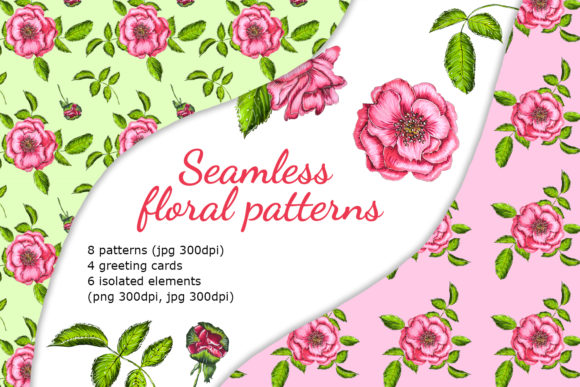
The collection includes 8 seamless patterns in JPEG format, sized at 26.67 inches height by 26.67 inches width. The term "seamless" is pivotal here. In textile and wallpaper manufacturing, a pattern must repeat infinitely without visible breaks or misalignments. A 26.67-inch square is a substantial tile size, reducing the frequency of repeats and creating a more organic, less repetitive visual flow on large surfaces. These patterns are immediately applicable to:
- Fabric Patterns: Creating custom quilting cotton, linen tablecloths, or fashion textiles.
- Wallpaper: Designing accent walls that bring biophilic design principles into indoor spaces.
- Packaging: Wrapping paper, gift bags, and product boxes that require a cohesive, branded aesthetic.
Pre-Sized Greeting Cards
Time is often the scarcest resource for creators. The inclusion of 4 greeting cards in JPEG format addresses this by providing ready-to-print layouts. The varied dimensions accommodate different standard envelope sizes and folding styles:
- 26.67 h x 34.52 w: Ideal for larger, folded announcements or invitation-style cards.
- 28.90 h x 37.40 w (Two variations): Perfect for standard A-style greeting cards with ample space for typography.
- 37.03 h x 22.24 w: A landscape orientation suitable for panoramic floral displays or thank-you notes.
These pre-formatted cards eliminate the guesswork regarding bleed lines and safe zones, allowing users to focus on personalization rather than layout mechanics.
Isolated Elements and the PSD Advantage
Perhaps the most powerful component for advanced customization is the 1 PSD file with 6 isolated elements, alongside corresponding JPG and PNG files sized approximately 3 h x 12.5 w. Photoshop (PSD) files preserve layers, meaning the individual marker-drawn rose hips and leaves are separated from the background. This modularity empowers users to build their own unique compositions. You are not locked into the designer’s original arrangement; instead, you can scatter buds across a banner, cluster leaves for a mug design, or create bespoke wall art that matches a specific room’s color palette.
Practical Applications in Modern Creativity and Business
The relevance of floral digital paper and greeting cards extends far beyond hobbyist crafting. In today’s marketplace, small businesses and independent artists rely on such assets to establish brand identity without commissioning expensive custom illustrations.
Home Decoration and Interior Styling
Biophilic design—the integration of nature into built environments—is a dominant trend in modern interiors. Rose hip motifs offer a sophisticated alternative to tropical or spring florals. Using these seamless patterns for throw pillows, framed prints, or even decoupage furniture restoration allows homeowners to curate spaces that feel curated and timeless. The hand-drawn quality adds a layer of "wabi-sabi," celebrating imperfection and natural beauty in an increasingly sterile digital world.
Product Packaging and Brand Identity
For sellers on platforms like Etsy or Shopify, packaging is a tangible touchpoint with customers. Utilizing these 100 hand-drawn marker illustrations creates a cohesive unboxing experience. A soap maker might use the seamless pattern for box liners, the isolated elements for sticker labels, and the pre-sized greeting cards as thank-you inserts. This consistency builds brand recognition and perceived value. The organic nature of rose hips pairs particularly well with sustainable, eco-friendly, or artisanal product lines.
Educational and Therapeutic Uses
Beyond commerce, these assets serve educational and therapeutic purposes. Botanical illustration has long been used in biology education to teach plant morphology. High-resolution, accurate depictions of rose hip structures can supplement textbooks or homeschooling curricula. Furthermore, the act of arranging isolated floral elements digitally can serve as a form of art therapy, providing a low-pressure creative outlet that combines mindfulness with digital skill-building.
Common Misunderstandings About Digital Floral Assets
When incorporating raster-based floral assets into professional workflows, several misconceptions can lead to suboptimal results. Clarifying these ensures better outcomes.
Misconception 1: "Digital means infinite scaling."
Unlike vectors, raster files (JPEG/PNG) have a fixed pixel dimension. While 300dpi at 26.67 inches is large, stretching it to cover a billboard will degrade quality. Always check final print dimensions against source file resolution.
Misconception 2: "Seamless patterns are automatically perfectly aligned." While the source files are seamless, printing variables (fabric shrinkage, printer margins) can affect alignment. Always order test swatches before committing to bulk production for fabric or wallpaper.
Misconception 3: "Hand-drawn equals messy." Some assume marker illustrations lack precision. However, professional digitization cleans up stray marks while retaining intentional texture. These assets strike a balance: they are polished enough for commercial use yet retain the human touch that defines their charm.
Maximizing Your Creative Potential
Owning a collection of beautiful seamless patterns with buds and leaves of rose hip and greeting cards is merely the starting point. True value emerges through experimentation. Mix the isolated elements with solid color blocks for minimalist stationery. Layer multiple pattern tiles at varying opacities for depth in digital scrapbooking. Use the PSD file to recolor elements to match seasonal trends—shifting from autumnal reds to winter silvers or spring greens.
The intersection of traditional artistry and digital utility represented by these 100 hand-drawn marker illustrations offers a rich playground for creators. Whether you are designing a wedding suite, launching a textile line, or simply seeking to beautify your living space, these assets provide the foundational elements necessary to bring organic warmth into any project. By understanding the technical specifications, respecting the medium’s characteristics, and exploring diverse applications, users can transform simple digital files into meaningful, tangible creations that resonate with viewers on a deeply human level.
Thank you for your interest in my product. May these rose hip illustrations inspire your next creative endeavor, bridging the gap between the garden and the screen with every stroke of digital ink.